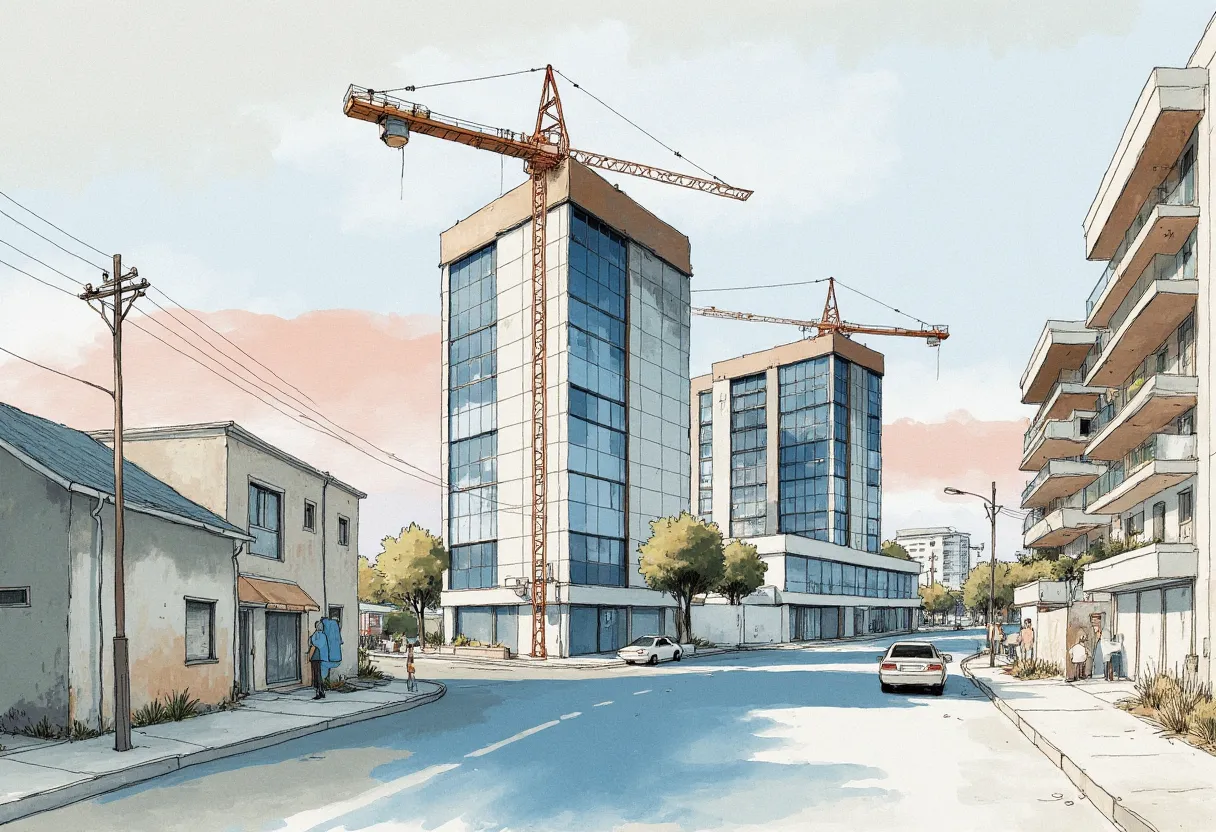
A Miami broker’s close tracking of Little River’s development cycle highlights a clear pattern: institutional investors consistently hold back from transitional neighborhoods until a significant project breaks ground, providing proof of concept and unlocking broader capital flows.
Jamie Maniscalco, President and Managing Broker at The Alpha Commercial, has spent her career specializing in transitional neighborhoods and says institutional investors rarely act as first movers. “People don’t want to be the first to the table, usually,” Maniscalco says. This reluctance, she explains, creates a critical inflection point for neighborhood growth. Only once a large-scale development begins construction do other institutional players feel confident enough to commit capital.
Maniscalco points to Miami’s Little River as a current example. “Little River, they finally broke ground on the first larger-scale development within the past six months, and that’s the Cedar Street project over on Second Ave,” she says. “Now that they’ve broken ground, I think that the other ones will feel safer to do the same. There’s going to be more action to come now that that’s already in place.”
The Proof of Concept Threshold
Maniscalco’s observations clarify how institutional capital evaluates risk in emerging markets. The initial developer in a transitional neighborhood faces the most significant uncertainty, as there is no guarantee that the area will attract buyers or tenants at projected levels. Once a project moves from planning to construction, it serves as proof of concept, reducing perceived risk for other investors.
This creates a precise sequence: the first large-scale project signals the neighborhood’s real traction, prompting a wave of additional development as other institutions follow. Maniscalco explains that this psychological and financial barrier is a key reason some neighborhoods with strong fundamentals remain stagnant for years. In contrast, others accelerate rapidly once the first project is underway.
For neighborhood development, the impact is significant. Areas that land an initial large-scale project often see a surge in institutional interest and a compressed timeline for further growth. Those lacking a proof of concept remain quiet, even if their underlying demographics and development potential are strong.
Maniscalco’s firm tracks proposed and active projects in Little River and has documented this effect. “Not much is under construction. There’s like one under construction,” she says. “But a lot of the information suggests breaking ground in 2026. People are finally getting serious about building once they see that first project move forward.”
Little River’s Unique Position in Miami’s Development Landscape
Maniscalco notes that Little River differs from earlier Miami neighborhood transformations she has been involved with, such as Edgewater and Wynwood. In those markets, a small group of dominant buyers made transactions relatively predictable. “In Edgewater, there were a few players that were really, really bullish on the market,” Maniscalco recalls. “All you really had to do was get the inventory listed, and you kind of already knew who the buyer was going to be in advance.”
Little River, by contrast, has a more fragmented pool of buyers. “It’s less predictable like that. There are some major players here and there, but not anywhere near as much. There are always new characters showing up,” she says.
This fragmentation suggests that Little River is maturing as a market, attracting a broader range of institutional players rather than remaining dominated by a few early adopters. However, it also means the initial proof of concept is even more critical, as no single buyer or group is likely to tip the balance.
Patterns Emerging in Other Miami Submarkets
Maniscalco sees similar dynamics in other Miami neighborhoods on the edge of institutional interest. “We also like Allapattah because that’s sort of a peripheral neighborhood to Wynwood. It’s still cheaper to get into,” she says. “I think Allapattah is going to see a lot of Live Local action coming.”
She also points to North Miami Beach as a market with untapped potential. “A couple of years ago, there was all this talk about a lot of projects coming on 163rd Street, and just nothing really happened,” Maniscalco notes. “I think that does have potential, but I think it’s going to take a couple more years.”
The difference between neighborhoods attracting institutional capital now and those still waiting appears to hinge on whether a significant project has broken ground. This supports Maniscalco’s view that proof of concept is not just necessary, but often decisive in triggering institutional investment in transitional neighborhoods.
Why This Pattern Matters Now
Miami’s current market environment, marked by heightened risk scrutiny and a focus on demonstrated returns, makes institutional investors even more cautious about unproven neighborhoods. Rising interest rates, higher construction costs, and a more selective lending climate have raised the stakes for early movers. As a result, the presence or absence of a groundbreaking project has become the clearest indicator of which neighborhoods will see accelerated development in the near term.
Little River’s Cedar Street project will serve as a clear test case. If, as Maniscalco predicts, more institutional players move in following this initial development, it will reinforce the idea that proof of concept remains the key catalyst for unlocking capital in transitional markets. Until then, neighborhoods without a significant project underway are likely to stay quiet, regardless of their underlying potential.
Maniscalco’s experience suggests that for brokers, developers, and investors seeking to anticipate where institutional capital will flow next, tracking groundbreakings and the momentum they generate provides the most reliable roadmap. In Miami and beyond, the first project to move from plan to construction is often the signal that the broader market has been convinced—and that real change is about to begin.