SAN FRANCISCO, Dec. 22, 2025 (GLOBE NEWSWIRE) -- Affiliate Disclosure: A commission may be earned if you purchase through links in this article, at no additional cost to you.
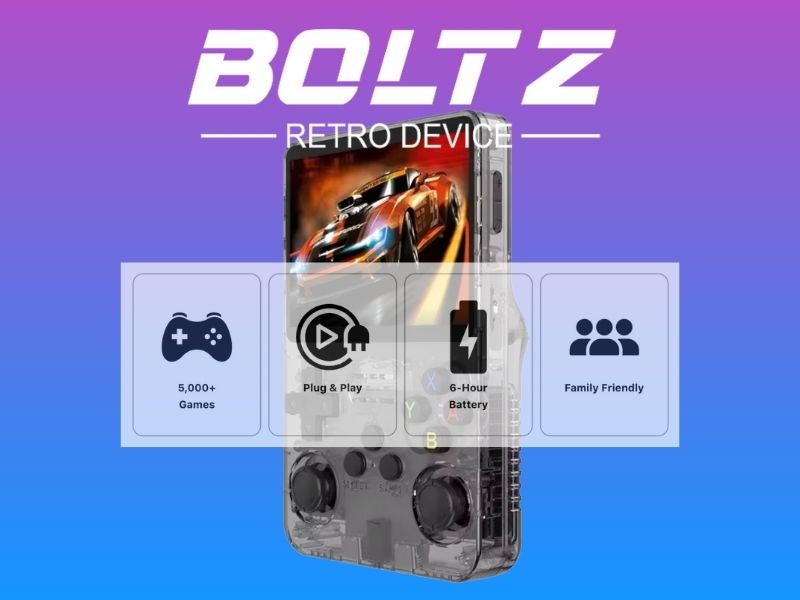
As families prepare for holiday travel and look ahead to entertainment options for 2026, boltzretrodevice.com is marketing a handheld gaming system that comes pre-loaded with classic video game titles from multiple console generations. Orders are fulfilled by the product provider via the buymeridian domain.
The timing aligns with specific challenges many families face: keeping children entertained during car trips, flights, and waiting periods without relying on internet connectivity. As the New Year approaches, parents are evaluating screen time options that balance entertainment value with control over content access.
The portable device, which the site describes as measuring pocket-sized, includes games spanning from 8-bit classics through PlayStation-era titles, all accessible without downloads, subscriptions, or Wi-Fi connectivity. According to the product page, the system boots instantly and requires no account setup or configuration.
Understanding the Retro Gaming Handheld Category
Before looking at the Boltz Retro Device specifically, it helps to understand what retro gaming handhelds are designed to do and who they typically serve.
Retro gaming handhelds emerged as a product category over the past decade as classic gaming experienced renewed interest among adults who grew up during the 8-bit through 32-bit console eras. These devices use emulation technology—software that mimics the operation of older gaming hardware—to run games originally designed for systems like Nintendo Entertainment System, Super Nintendo, Sega Genesis, and original PlayStation.
The category differs from modern gaming handhelds in several key ways. Modern devices like Nintendo Switch or Steam Deck connect to the internet, require account creation, support online multiplayer, and run current-generation games with cutting-edge graphics. Retro gaming handhelds, by contrast, focus exclusively on older titles, operate entirely offline, and prioritize portability and simplicity over graphical performance or online features.
For families, this distinction matters. A child using a Nintendo Switch can potentially access online chat, in-app purchases, and multiplayer lobbies with strangers. A retro gaming handheld with pre-loaded games operates offline with no Wi-Fi required, meaning online features such as chat or in-app purchases are not part of the described functionality. The games themselves come from an era before microtransactions and loot boxes became standard industry practices.
For adults seeking nostalgia, retro handhelds solve a different problem: accessing childhood favorites without maintaining multiple original consoles, dealing with degraded cartridges, or navigating compatibility issues between 30-year-old hardware and modern televisions. The original NES, for example, outputs composite video signals that many current TVs no longer support without adapters.
The Boltz Retro Device enters this established category as one option among many, differentiated primarily by its pre-loaded game library size, offline-first design, and the site's marketing toward family travel use cases.
Device Technical Specifications and Design Philosophy
The Boltz Retro Device features a layout combining traditional directional pad controls with dual analog joysticks, four action buttons (X, Y, A, B), and shoulder buttons (L1, L2, R1, R2) positioned to mirror modern controller standards. The front panel includes dedicated SELECT and START buttons, along with function controls for volume adjustment and system navigation.
This control layout reflects a design choice common in retro gaming handhelds: accommodating games from multiple console generations that had different control schemes. The directional pad handles 8-bit and 16-bit titles that relied on simple up/down/left/right movement. The dual analog joysticks support PlayStation and Nintendo 64-era games that introduced 3D movement and camera control. The shoulder button configuration matches the four-button standard that became common in the 32-bit generation.
According to specifications published on boltzretrodevice.com, the device includes:
- Rechargeable battery rated for up to 6 hours of continuous play
- 3.5mm headphone jack for private listening
- OTG port for peripheral connectivity
- DC power input for charging during use
- Indicator light system for power and battery status
- Dual microSD card slots (TF1-OS and TF2-GAME) for potential storage expansion
The battery specification deserves context. Six hours of continuous gameplay aligns with scenarios like cross-country flights, full-day road trips, or extended waiting periods. This differs from modern smartphones and tablets, which often struggle to maintain 3-4 hours of intensive gaming use even with larger battery capacities. The efficiency comes from running older, less graphically demanding games that require minimal processing power compared to current-generation titles.
The dual microSD slot configuration suggests technical architecture: one slot handles the operating system and emulation software, while the second manages game storage. This separation can protect the core system files from accidental deletion or corruption while allowing users to potentially swap game libraries, though the site does not explicitly market this capability.
The site lists multiple shortcut key combinations, including brightness adjustment (R3 + UP/DOWN), save and load game states (SELECT + L1/R1), and application exit (SELECT + START) without navigating menus. These shortcuts reflect a practical consideration for handheld gaming: the faster you can adjust brightness or save your progress, the less time you spend in system menus instead of actually playing.
Game Library Composition and Organization
Marketing materials describe the library as ranging from "hundreds" to "5,000+" titles depending on package; the MAX upgrade references "20,000 games" and 128GB storage. According to the product page, the library spans multiple classic gaming platforms including NES, SNES, Sega Genesis, PlayStation, Game Boy, and arcade systems. A detailed game list has not been published.
This lack of a published game list is common in the retro gaming handheld market and relates to the licensing complexities discussed later in this article. When devices include pre-loaded games, manufacturers rarely publicize complete inventories, likely to avoid drawing attention to specific titles that remain under active copyright protection.
An optional upgrade tier marketed as the "MAX Edition" reportedly expands storage to 128GB and increases the game library to 20,000 titles. The site describes this version as including an "enhanced performance processor" designed for smoother emulation of higher-end classic systems.
The library size escalation from hundreds to 20,000 titles with the MAX edition suggests the inclusion of game libraries from additional platforms or deeper catalogues from the core systems. For context, the original NES library consisted of approximately 700 officially licensed titles in North America. The Super Nintendo library contained roughly 720 games. Sega Genesis had about 880 titles. When you combine all 8-bit and 16-bit console libraries from multiple regions (North America, Japan, Europe), you approach several thousand unique titles.
Reaching 20,000 games likely requires including arcade ROM sets, unlicensed titles, homebrew games created by modern developers for retro platforms, or games from additional systems like Neo Geo, TurboGrafx-16, Atari systems, and various handheld platforms beyond Game Boy.
The device's interface, according to operational documentation, allows users to browse games by platform, genre, or through search functionality. The system supports save states, enabling players to pause progress at any point and resume later—a feature not available in original hardware for many of these classic titles.
Save states represent one of the most practical advantages of emulation over original hardware. Classic games often lacked save functionality entirely or relied on battery-backed save systems that could lose data when batteries died. Many challenging games required players to complete entire sessions in one sitting or memorize passwords to resume progress. Save states allow you to stop anywhere—mid-level, mid-boss fight, mid-jump—and return exactly to that moment later. For parents, this means the device can be immediately stowed when it's time to board a plane or when a child needs to suddenly focus on something else.
Why Offline Gaming Matters for Family Travel in 2026
The site markets the device's offline functionality—no Wi-Fi required—at a moment when internet-dependent entertainment dominates the market. This design choice addresses several practical realities families face during travel.
Connectivity Gaps Remain Common: Despite expanding Wi-Fi availability, connectivity gaps persist. Rural highway stretches between cities often lack reliable cellular data. Budget airlines charge for in-flight Wi-Fi, and even when available, bandwidth limitations make streaming video games impractical. International travel introduces roaming charges that make data-intensive entertainment expensive. Hotel Wi-Fi in some destinations remains unreliable or requires payment.
Subscription Fatigue Influences Entertainment Choices: The average family now manages multiple entertainment subscriptions—streaming video services, music platforms, gaming services like Nintendo Switch Online or PlayStation Plus. Each service adds monthly costs that compound over the year. A device with pre-loaded content removes one recurring charge from the household budget.
Offline-Only Use Means Static Library: Operating offline with no Wi-Fi required means the game library remains static. What's preloaded is what's available. Parents don't face scenarios where children access new content without permission, encounter in-app purchase prompts, or discover age-inappropriate games through app store browsing.
Screen Time Without Algorithm Exposure: Modern entertainment platforms use recommendation algorithms designed to maximize engagement—which often means suggesting one more video, one more episode, one more level. Classic games from the 8-bit and 16-bit eras were designed with clear endpoints. Most games from that era can be completed in 4-12 hours of gameplay. This structure creates natural stopping points rather than endless engagement loops.
Educational Value of Classic Game Design: Games from the 8-bit and 16-bit eras required spatial reasoning, pattern recognition, timing precision, and problem-solving without extensive tutorials or objective markers. Modern games often include waypoint systems and arrow indicators showing players exactly where to go. Classic games required players to explore, experiment, and figure out solutions through trial and error. For families interested in gaming as a cognitive development tool, this design philosophy offers something distinct from current-generation titles.
These factors combine to describe offline retro gaming devices as serving a specific family entertainment niche: portable entertainment for situations where internet connectivity is unreliable, expensive, or deliberately avoided.
Target Use Cases Heading Into 2026
According to customer materials published on boltzretrodevice.com, primary use cases include:
Holiday Travel Entertainment: The immediate timing aligns with the holiday travel season. Families visiting relatives often face long car rides, airport delays, and situations where children need quiet entertainment while adults handle logistics. The New Year travel period represents one of the busiest travel weeks annually, with families returning home after holiday visits.
2026 Road Trip Planning: As families plan summer 2026 vacations, entertainment options become part of trip preparation. A device that provides hours of gameplay without requiring hotel Wi-Fi or mobile data connections addresses a specific pain point for families visiting national parks, rural destinations, or camping locations.
Gift-Giving for Multiple Generations: The nostalgia factor aligns with potential gift scenarios from adults who grew up in the 1980s and 1990s to children or younger relatives. The shared cultural reference points—recognizable characters, familiar game mechanics, classic soundtracks—can create what customer materials describe as "multi-generational gaming sessions" where adults and children play together.
Quiet Time Entertainment: Customer materials emphasize scenarios where children need entertainment that doesn't disturb others—late-evening play when siblings are sleeping, waiting room situations at medical appointments, restaurant waiting periods, or long car rides where audiobook or music choices conflict among passengers. The headphone jack enables private audio without disturbing fellow travelers or family members.
Budget-Conscious Entertainment Consolidation: The site markets the device as an alternative to purchasing individual classic game compilations across multiple platforms or maintaining multiple subscription services. For families evaluating entertainment expenses heading into 2026, a one-time purchase that provides access to a pre-loaded library may compare favorably to ongoing subscription costs.
Nostalgia-Driven Personal Use: Adults who want to revisit childhood gaming experiences without maintaining original hardware represent another use case. Original NES, SNES, and Genesis consoles require specific cable connections, cartridge maintenance, and storage space. The portability factor adds use cases that weren't possible with original hardware—playing classic games during work lunch breaks, travel downtime, or casual evening sessions without occupying the main television.
Introduction to Gaming Without Online Features: The FAQ notes the device is best suited for children aged 3-6 with adult supervision due to small parts and battery usage, though customer materials suggest users across multiple age ranges have successfully operated the system. For parents introducing gaming to young children, starting with classic titles removes the complexity, social pressures, and monetization tactics present in modern gaming ecosystems.
How This Differs from Other Entertainment Options
Understanding where the Boltz Retro Device fits in the broader entertainment landscape helps clarify who it serves effectively.
Versus Tablets and Smartphones: Tablets and smartphones offer enormous app libraries and multimedia functionality that retro gaming handhelds cannot match. However, they require internet connectivity for most gaming content, expose children to browser access and app store browsing, and often struggle with battery life during intensive gaming use. Parents concerned about screen time management often find tablets difficult to limit because the same device that runs educational apps also provides access to social media, web browsing, and endless video content.
The Boltz Retro Device does one thing only: play pre-loaded games. This limitation is the functional characteristic for families seeking single-purpose entertainment devices. There's no browser to accidentally open, no app store to explore, no social media to access. The device's single purpose makes it easier to set boundaries around use.
Versus Modern Gaming Handhelds: The Nintendo Switch offers current-generation gaming with online features. The Steam Deck provides access to PC games but requires technical knowledge to configure. These modern handhelds serve different needs than retro gaming devices. They're for families who want current games, online multiplayer, and premium gaming experiences. Retro handhelds serve families prioritizing simplicity, offline use, and pre-loaded content libraries.
Versus Official Classic Game Compilations: Nintendo, Sega, and Atari have released official classic game compilations on modern platforms. These offer verified licensing and typically better emulation quality than third-party devices. However, the libraries are much smaller—typically 20-40 games per compilation—and require purchasing multiple collections to access variety.
The tradeoff is licensing certainty and emulation quality versus library breadth and upfront cost. This article addresses the licensing question in detail in the section below.
Versus Original Hardware: Collectors and purists often prefer playing games on original hardware for the authentic experience. However, original consoles require cartridge or disc maintenance, often need modern TV adapters, take up storage space, and require separate purchases for each game.
The Boltz Retro Device offers convenience and library breadth at the expense of authenticity. You're playing emulated versions of games rather than running original code on original hardware. For most casual players, this distinction doesn't meaningfully affect the experience. For collectors and authenticity-focused players, emulation may feel like a compromise.
Purchasing Structure and Shipping Information
According to boltzretrodevice.com, the system is available online via the provider checkout. The site reports shipping from a New Jersey warehouse via USPS, FedEx, or UPS, with stated delivery timeframes of 5-7 business days for standard shipping within the United States. Orders process within 48 business hours according to posted policies. International orders are handled through DHL.
The domestic warehouse location matters for buyers evaluating delivery speed and return logistics. Products shipping from overseas warehouses often face 2-4 week delivery windows and complicated international return processes. The New Jersey fulfillment location aligns with faster delivery within the contiguous United States and simplifies return handling for customers within domestic shipping zones.
Pricing structures include single-unit purchases and multi-unit bundles. The tiered approach suggests the provider anticipates buyers purchasing multiple units—potentially as gifts for multiple children, extended family members, or as backup devices for family households with multiple children.
According to current terms published on the site, purchases are backed by a 30-day satisfaction guarantee allowing returns for refund, minus shipping and handling costs. The provider reserves the right to assess a minimum 15% restocking fee on returns.
The 30-day window provides time to evaluate the device through actual use rather than initial impressions. For a gaming device, meaningful evaluation requires playing multiple games, testing battery life through typical use, and determining whether it fits intended use cases. A 7-day return window might not allow sufficient testing; 30 days provides more realistic evaluation time.
The restocking fee structure is common in consumer electronics returns and reflects the reality that returned devices require inspection, potential refurbishment, and repackaging before resale.
An optional extended protection program is offered at checkout; terms and pricing vary. According to the site, extended coverage includes defects, damage, loss, and theft protection. This positions the protection plan beyond standard manufacturer defect warranties to include accident and loss scenarios that standard warranties typically exclude.
For families purchasing the device as a child's entertainment tool, protection against accidental damage makes practical sense. Devices used during travel, handled by young children, or used in outdoor settings face higher damage and loss risk than devices that remain stationary in controlled home environments.
Understanding the Licensing Context
Emulation hardware exists broadly in the consumer electronics market. The licensing status of preloaded game libraries varies depending on distribution methods and publisher authorization.
Emulation Technology and ROM Distribution: Emulation technology—software that mimics the operation of one system on another—differs from distributing copyrighted game software (ROMs). Game publishers hold copyrights on their software, and those copyrights persist for decades after original publication.
The Practical Reality: Many games from the 8-bit and 16-bit eras are no longer commercially available through official channels. Publishers have discontinued production, original hardware is no longer manufactured, and games aren't available on modern digital storefronts. This creates what some call "abandonware"—software that rights holders no longer actively monetize but haven't released into public domain. Copyright holders retain their rights whether or not they're actively exercising them.
Alternative Options for Licensing-Conscious Buyers: Buyers who prefer verified licensing can consider compilation releases from established gaming companies. Nintendo offers classic game access through Nintendo Switch Online subscription service. Sega has released multiple official Genesis compilations across platforms. Atari maintains an official store for their classic catalog. These alternatives feature smaller game libraries but provide clear licensing authorization.
The tradeoff is library size versus licensing certainty. Official channels might provide 50-100 games with verified authorization. Third-party retro handhelds claim thousands of titles without published licensing details. Different buyers will weigh these factors differently based on personal priorities around intellectual property compliance.
The marketplace terms explicitly state the operator makes no representations about permits, licenses, or proprietary rights. Buyers concerned about licensing should conduct independent research and consult qualified legal counsel before purchasing.
Battery Life and Power Management
The stated 6-hour battery life deserves detailed examination because battery performance significantly affects real-world usability.
Six hours represents continuous gameplay time, which differs from standby time. The device presumably enters sleep mode when unused, extending time between charges. For travel scenarios, this matters—if the device sleeps efficiently between use sessions, a single charge might last across multiple days of intermittent play rather than requiring nightly charging.
Battery life varies based on several factors:
Game Complexity: Simple 8-bit titles like original Super Mario Bros. require minimal processing power and likely consume less battery than PlayStation-era 3D games that demand more intensive emulation.
Screen Brightness: The shortcut to adjust brightness (R3 + UP/DOWN) isn't just convenience—it's battery management. Lower brightness settings extend battery life substantially. In well-lit airplane cabins or outdoor settings, maximum brightness may be necessary for visibility. In dimmer environments, reducing brightness can add hours of play time.
Audio Use: Speaker playback consumes more power than headphone output. The headphone jack becomes an efficiency feature as well as a courtesy-to-others tool.
Save State Frequency: Writing data to storage consumes power. Frequent save state use (which the device supports through SELECT + L1/R1 shortcuts) may incrementally reduce battery life compared to playing without saving.
For families planning full-day road trips or transcontinental flights, understanding these variables helps set realistic expectations. Six hours might extend to 8-10 hours with aggressive power management (lower brightness, headphones, moderate save state use), or compress to 4-5 hours with maximum brightness and frequent save state use.
The DC power input allowing charging during use becomes crucial for extended travel. In cars with USB power outlets or airplanes with seat power, the device can maintain charge throughout use, effectively providing unlimited play time with wall power access.
Device Management Considerations
For families evaluating the device heading into 2026, several management considerations apply.
Offline-Only Operation: The fully offline operation—no Wi-Fi required—means the game library remains static. What's preloaded is what's available. Parents don't face scenarios where children access new content without permission, encounter in-app purchase prompts, or discover age-inappropriate games through app store browsing.
Defined Endpoints: Classic games from the 8-bit and 16-bit eras typically feature level-based structure with clear completion points. A parent can establish rules like "you can play until you complete this level" or "you can play three levels" that align with the game's natural structure. This differs from modern games with continuous progression systems and engagement loops designed to blur natural stopping points.
Pause-Anywhere Functionality: The save state feature allows parents to end play sessions immediately without forcing children to "just finish this part." In original hardware, losing progress by turning off mid-level created resistance to stopping. Save states remove that friction—progress is preserved no matter when play stops.
Visual Cues for Battery: While the device doesn't appear to include parental control features like time limits or play session restrictions, the battery indicator provides a natural endpoint. "You can play until the battery runs down" creates a defined limit without parent-child negotiation about arbitrary time limits.
Single-Purpose Device: Because the device only plays games—it doesn't browse the web, access social media, or run educational apps—it occupies a clearer category in household device management. It's entertainment, full stop. This clarity can make it easier to establish boundaries compared to multipurpose devices that serve both productive and entertainment functions.
No Built-In Parental Controls: The device apparently doesn't include built-in parental controls, usage tracking, or content restriction features that some modern gaming devices offer. Parents can't remotely monitor play time, lock specific games, or set time limits through device settings. All management happens through physical access control—the device plays when it's available, stops when it's taken away.
Families who prefer technical parental control features may find this limitation significant. Families comfortable with physical device management may find the simplicity appealing.
Technical Support and Customer Service Framework
According to boltzretrodevice.com, the provider handles inquiries related to product functionality, shipping status, returns, and warranty claims. Understanding the support structure helps set expectations for post-purchase assistance.
Product Support Channels: The site lists email (support@buymeridian.co) and phone (+1 866-673-3146) as primary support contacts. The availability of phone support differentiates the offering from some direct-to-consumer electronics that provide email-only assistance. For troubleshooting technical issues or processing returns, phone support can resolve questions more efficiently than email exchanges.
Website Operations Contact: The separate email (contact@boltzretrodevice.com) for website-specific questions reflects the marketplace structure discussed below. Product functionality questions go to the fulfillment provider; website operational questions go to the marketplace operator. This separation matters for directing inquiries appropriately.
Response Time Expectations: The site doesn't publish specific response time commitments. Industry standards for consumer electronics support typically range from 24-48 hours for email inquiries and immediate to 15-minute hold times for phone support, though actual performance varies.
Return Process Detail: According to posted policies, customers initiate returns by contacting support@buymeridian.co with full name and order email address. The provider inspects returned items and processes refunds within 5-10 business days after inspection. This timeline means the complete return cycle from initiating return to receiving refund could span 2-3 weeks when accounting for shipping time both directions and the inspection/refund processing window.
Extended Protection Claims: The optional extended protection program presumably includes a separate claims process for damage, loss, or theft scenarios. The site doesn't detail the claims process, required documentation, or approval criteria in publicly available materials. Buyers considering the protection plan should request claims process details before purchasing to understand what documentation is required and how claims are adjudicated.
Frequently Asked Questions
How does the 30-day guarantee work?
According to the return policy, customers may return the product within 30 days of receipt for a refund, less shipping and handling costs. The item must be in the same condition as received and in original packaging. The provider reserves the right to charge a minimum 15% restocking fee on returns. Refunds are processed within 5-10 business days after return inspection. To initiate returns, customers contact support@buymeridian.co with full name and order email address.
What age range is the device designed for?
The FAQ section indicates the device is best suited for children aged 3-6 with adult supervision due to small parts and battery usage. However, customer materials suggest users across multiple age ranges have successfully operated the system. The control scheme complexity and game content suggest the device serves children old enough for coordinated button pressing (typically age 4-5 and up) through adults revisiting nostalgic titles. Very young children (under 4) may struggle with the button combinations and game mechanics.
Does the device require any subscriptions or ongoing costs?
According to product specifications, the Boltz Retro Device operates entirely offline with no subscription fees, account requirements, or in-app purchases. The only ongoing cost would be electricity for recharging the battery, which represents minimal expense.
How do I connect it to a television?
According to the FAQ section, the device can connect to televisions via HDMI port using the included USB cable for power. Users switch to the corresponding HDMI input to display gameplay on the TV screen. The site markets this as enabling both home console use on a television and portable use for travel.
Where does the product ship from?
According to the shipping policy, orders are sent from a New Jersey warehouse. Standard delivery is listed as 5-7 business days via USPS, FedEx, or UPS. International orders are shipped via DHL. Orders process within 48 business hours according to posted policies. For buyers purchasing during the holiday season, understanding that processing begins within 48 hours helps set delivery expectations when accounting for carrier volume during peak shipping periods.
Are the games pre-installed or do I need to download them?
All games in the library are pre-installed on the device. No downloads, account creation, or initial setup is required according to the site. This plug-and-play approach means the device can be used immediately after unboxing and charging—no configuration, no software updates, no account credentials. This simplicity particularly benefits less tech-savvy users like elderly relatives or young children who might struggle with setup processes that modern gaming devices typically require.
What if I'm not satisfied with my purchase?
The provider offers a 30-day guarantee allowing returns for refund. To initiate a return, customers contact support@buymeridian.co with their full name and order email address. The provider inspects returned items and processes refunds within 5-10 business days. Items must be returned in the same condition received, and a minimum 15% restocking fee may apply. The return shipping cost is the customer's responsibility according to standard return policies, though the site doesn't explicitly state this—buyers should confirm return shipping responsibility before purchasing.
Can I add more games to the device?
The site doesn't provide detailed instructions on adding games, though the dual microSD card slot configuration suggests technical possibility. The TF2-GAME slot designation implies it handles game storage, which could theoretically allow swapping storage cards with different game libraries. However, without published instructions or official support for this capability, buyers should assume the device functions with the pre-loaded library only.
What happens if the device breaks after the 30-day return window?
Standard purchases beyond the 30-day satisfaction guarantee period would depend on any applicable manufacturer warranty, which the site doesn't detail in publicly available materials. Buyers can purchase the optional extended protection program at checkout, which according to the site covers defects, damage, loss, and theft. The extended protection positioning suggests standard warranty coverage may be limited, making the extended program potentially valuable for buyers seeking long-term protection.
Does it play games from [specific console]?
The site lists NES, SNES, Sega Genesis, PlayStation, Game Boy, and arcade systems as included platforms. Other classic systems like Nintendo 64, Sega Saturn, Dreamcast, or more modern platforms are not mentioned in publicly available materials. The absence of specific mention doesn't definitively mean exclusion—the library count in the MAX edition could include additional platforms—but buyers interested in specific systems should contact the provider to confirm platform support before purchasing.
Can multiple people save progress in the same game?
The save state system (SELECT + L1/R1) appears to allow saving at any point, but the site doesn't detail how many save slots are available per game or whether multiple save files can coexist. Classic games on original hardware sometimes supported multiple save files (through battery-backed saves or memory cards), but emulation implementation varies. Families with multiple children who want separate progress tracking in the same games should confirm save file capabilities before purchasing.
Marketplace Operations and Business Structure
According to the terms of use published on boltzretrodevice.com, the website operates as an advertising marketplace with a material financial connection to product providers through compensation for clicks and sales. Understanding this structure helps clarify roles and responsibilities.
Marketplace vs. Direct Seller: The site explicitly states it is not a news publication or consumer protection resource. Order fulfillment, customer support, and product warranties are handled by the product supplier—not by the marketplace operator. This means boltzretrodevice.com functions as a marketing platform that connects potential customers with the product provider, but doesn't handle the transaction or post-purchase support directly.
Practical Implications: When customers encounter issues with orders, shipping, product functionality, or returns, those inquiries go to the product supplier's support channels (support@buymeridian.co) rather than to the marketplace operator. The marketplace's role ends at connecting the customer to the provider's checkout system.
Financial Connection Disclosure: The terms acknowledge a material financial connection through compensation for clicks and sales. This aligns with FTC guidance on affiliate relationships and material connections. The marketplace earns compensation when customers purchase through links from the site, creating an inherent financial incentive to present products favorably.
Consumer Protection Framework: The product supplier's terms and conditions govern all purchases. Buyers should review those terms during checkout to understand their rights, return policies, warranty coverage, and dispute resolution processes. The marketplace terms don't supersede or replace the supplier's terms—they operate in parallel, with supplier terms controlling the actual transaction.
Why This Structure Matters: Understanding the marketplace model helps buyers direct questions appropriately. Website navigation or content questions go to contact@boltzretrodevice.com. Product questions, orders, shipping, returns, and technical support go to support@buymeridian.co or the phone line listed above. Conflating the two channels can delay issue resolution.
Competitive Context Without Comparative Claims
The retro gaming handheld market includes numerous products from various manufacturers and sellers. Without making comparative quality or performance claims, it's helpful to understand the general market landscape as context for evaluating any specific option.
Price Range Spectrum: Retro gaming handhelds in the current market range from budget options for basic single-system emulation devices to premium handheld consoles with higher-resolution screens, more powerful processors, and advanced customization features. The site markets the Boltz Retro Device within the mid-range segment based on described specifications.
Library Size Variables: Devices claiming pre-loaded game libraries range from hundreds to tens of thousands of titles depending on storage capacity and which gaming systems are emulated. Larger numbers aren't automatically better—the playability and quality of included games matters more than raw count. A device with hundreds of highly-playable classics may provide more value than a device with thousands of titles where the majority are obscure, broken, or poor-quality.
Build Quality Spectrum: The market includes budget devices with basic plastic construction and minimal build quality alongside more expensive options with premium button mechanisms and high-resolution screens. Component quality affects durability, tactile feel, and screen visibility in different lighting conditions. The Boltz Retro Device specifications don't detail construction materials or screen specifications in available materials.
Support and Warranty Variations: Some retro gaming handhelds come from established electronics brands with clear support channels and warranty terms. Others come from overseas suppliers with limited English-language support or complicated return logistics. The Boltz Retro Device's domestic warehouse location and phone support availability differentiate it from products shipping directly from Asian manufacturers.
Open vs. Closed Systems: Some retro handhelds arrive as open platforms designed for users to add their own game files, install emulators, and customize the experience. These typically attract technically-minded users who want control over configuration. Others, like the site describes for the Boltz Retro Device, arrive as closed systems with pre-loaded content designed for immediate use without customization. Neither approach is inherently superior—they serve different user preferences.
This context helps buyers understand where any specific device fits in the broader market without making claims about which option is "best" or "top-rated" relative to others.
Contact Information
For questions about the Boltz Retro Device product, customer support, shipping, returns, or warranties, according to the provider's contact information:
Product Support:
Email: support@buymeridian.co
Phone: +1 (866) 673-3146
Website Operations:
Email: contact@boltzretrodevice.com
View current product information at boltzretrodevice.com
Disclaimers
Editorial Disclaimer: This article is for informational purposes only. The information provided reflects publicly available details from boltzretrodevice.com. The product and service descriptions are based on materials provided by the marketplace operator and product provider. Readers are encouraged to verify all details directly with the provider before making purchasing decisions.
Product Claims Disclaimer: All product features, specifications, and claims are attributed to marketing materials published on boltzretrodevice.com and have not been independently verified by the publisher. Customer materials represent individual accounts and should not be interpreted as typical results.
FTC Affiliate Disclosure: This article contains affiliate links. If you purchase through these links, a commission may be earned at no additional cost to you. This compensation does not influence the information presented.
Pricing and Terms Disclaimer: All pricing information, promotional offers, and guarantee terms mentioned were based on publicly available information at the time of publication (December 2025) and are subject to change without notice. Always verify current pricing, promotions, and guarantee terms directly with the provider before purchasing.
Publisher Responsibility Disclaimer: The publisher has made every effort to ensure accuracy at the time of publication based on publicly available information. We do not accept responsibility for errors, omissions, or outcomes resulting from the use of the information provided. Readers are encouraged to verify all details directly with the provider.
Licensing Context Disclaimer: The licensing status of pre-loaded game libraries on emulation devices involves complex legal considerations that vary by jurisdiction. This article provides general context about the retro gaming handheld market and emulation technology but does not make legal determinations about specific products. The marketplace terms explicitly state the operator makes no representations about permits, licenses, or proprietary rights. Consumers concerned about intellectual property compliance should conduct independent research and consult qualified legal counsel before purchasing.
Marketplace Notice: According to boltzretrodevice.com terms, the website operates as a marketplace and is not the direct manufacturer. The website owner has a material financial connection to the product provider through compensation for clicks and sales. Product returns, support, and shipping are handled by the product supplier. The product supplier's terms and conditions govern all purchases.
Third-Party Responsibility: The publisher is not responsible for product returns, customer service, shipping delays, warranty claims, or any issues related to product functionality. All such matters should be directed to the product supplier using the contact information provided above.
This article represents an advertising marketplace communication. All trademarks, logos, and brand names are the property of their respective owners.

Email: support@buymeridian.co Phone: +1 (866) 673-3146